PENA DE MUERTE FINAL DE BOLIVIA (2026) | Text and Direction: Aramburo
| Lecture Performance | Official Selection: It’s The Real Thing! — Basel, 2026
| Premio Nacional Eduardo Abaroa 2025 – Mejor Obra de Literatura Dramática, BO)
In 1927 a Bolivian film was censored, discarded and declared extinct. The only copy within reach is a YouTube upload under a Chilean institutional seal. The artist does not look for the restored original: they point a small camera at their own laptop screen and film the film. The dirty pixel is the trace of that decision, not the result of a limit. (Pena: penalty, and grief.)
LETTERS (2026) | Diego Aramburo & Beatrice Fleischlin
| Performance | Fachausschuss Tanz&Theater BS/BL (Expert Committee), Basel (CH)
| Official Selection: FIBA 2026 (Argentina), FITAM 2027 (Chile). Kaserne Basel 2026 (Switzerland)
Two artists born in 1971, one in Bolivia, one in Switzerland, write to each other old fashion letters. On stage: two chairs, two sheets of paper, words and a surtitles. The letters go back to a time before ‘queer’ had a code, and toward theirs mothers who will soon be absent and their children. The time a letter takes to arrive are the material.
«Transforms personal experience, from simple private confidence, into a critical accounting of its own place of enunciation.» —Juan Malebrán, La Ramona Cultural (Bo)
CRITICAL TRANSLATION / TRADUCCIÓN CRÍTICA (2026)
| Concept: Diego Aramburo & Claudia Pacheco / Development: A. Siles, C. Pacheco, D. Aramburo
| Transmedia AI Research / Interactive Installation | Goethe-Institut Arts+Digitality Grant (DE)
A machine that contextually-translates a text while the audience watches. And visibly falls short. The audience writes/asks, the screen/s develop alternative possible meanings and implications. The gap between what a language says and what an algorithm can carry is the subject.
A OJOS CERRADOS / EYES CLOSED (2022) | Diego Aramburo
| Research-based Archive / Multichannel Video Installation
| Real Academia de España en Roma – RAER (ES)
For months the artist shared meals and slow routines with persones in Italy, in the spirit of acullico (the Andean practice of chewing coca together). The result is a wall of video portraits: each person looks into the camera, then closes their eyes. Closed eyes refuse to be consumed (Glissant’s right to opacity) and turn the viewer into the one being looked at. The research on acullico took place in a country where the leaf exists only as police evidence, inside the Spanish Academy that funded it.
THE CONVERSATION PROJECT (2018–2030) | Diego Aramburo & Boris Nikitin
| Durational Research / Book | Pro Helvetia Co-Production Grant (CH)
Two artists, one Bolivian, one Swiss, agree to keep talking for twelve years before publishing the book that comes out of it: A Propaganda Book. Their own exchange is the propaganda apparatus —culture, politics, ideology— and the work takes it apart from inside, turning personal stories into tools and watching how a ‘truth’ gets made and how conviction performs. Time is the editor.
LEYES / LAWS (2020) | Diego Aramburo
Performative Video-Essay in three chapters | Focuart Municipal Funds (BO)
| Official Selection: FIBA (Argentina), Cenas Curtas (Brazil)
The image is layered and the viewer decides what to watch and when: the piece exists only if someone chooses. Face-filter apps, legal press and video put the laws of a state, a social network and a stage side by side, and ask who has to rehearse them and who never does.
«Aramburo transforms observation into a performative process… ‘Leyes’ is a creation that specifically addresses the danger posed by the ridiculous spectacularization of politics.»
RUY FILHO / Antropositivo, Brazil/Portugal.
GENERO (2018) | Diego Aramburo
| Performative Research / Multi-channel Installation | Iberescena Funds (ES)
| Eduardo Abaroa Award – Mejor Proyecto de Arte (2017) | Official Selection: FITE (Quito, EC)
Eight years after changing their legal gender, the non-binary artist builds, each time, a work from the contradiction: the masculine presence they keep, the female legal status they hold. Public reactions —media figures, social networks, even activists who claim to resist— contradict even themselves. Nothing is resolved; the patriarchy shows up inside the artist’s own habits.
Género: gender, genre, and, without the accent, «I generate».
MORALES (2014–Ongoing) | Diego Aramburo
| Durational Performance | National Theatre Award (2015), Abaroa National Art Award (2016)
| Official Selection: Winter Nights (Estonia), Miradas (Brazil), FITCRUZ (Bolivia), FIC (Bolivia)
In three repeating chapters, the performers exchange the physical sequences of their most socially unacceptable actions. In real time each decides whether to learn and perform the other’s action or to censor it. The audience stands inside the radius of the action. Morales: morals, also family name.
«Aramburo dares to put his finger on a wound that oozes its own sap
[…] deeply political, incorrect and accurate.»
JUAN MALEBRAN / Diario La Razón, Bolivia.
HEJAREI (2015-Ongoing)
| Concept and Direction: Aramburo; Creation C. Rocha & D. Aramburo
| Durational Dance Performance | Official Selection: Miradas (Brazil)
5 to 27 women performers, a couple of hours of sustained physical effort, and a score of verbs: let go, don’t force, offer, offer your blood, offer yourself. The work does not document the collective Guaraní suicides the anthropologist Bartomeu Meliá wrote about: it takes ‘to let go’ as a compositional rule, and asks what form of sovereignty is chosen and when the body stops being useful to the system. Hejarei is Guaraní for ‘let go’.
BEFORE:
Among other works: Crudo (2004, National Theater Award) · Fragmentos líquidos (2005; translated in París, published in Madrid; La Mousson d’Été 2010) · Macbett (Théâtre du Trident, Québec, 2009; first director resident in Bolivia staging a Large Format Stage Production in an Offitial Theater abroad) · La librería (Córdoba, 2010) · Medea (Théâtre du Trident, Québec, 2011) · Hamlet de los Andes (2012; Best Foreign Performance, Gran Teatro del Mundo Awards, Argentina, 2014) · Lysistrata (Teatro Nacional Sucre, Quito, 2012) · Romeo y Julieta de Aramburo (2013; festivals in thirteen countries) · Scufița Roșie (Teatrul Gong, Rumania, 2017; Impuls Theater Award 2019).
«A complex vision of the body as disobedient par excellence… a ritual atmosphere of a dislocated cinema.» JORGE LUNA ORTUÑO / Diario Opinión.
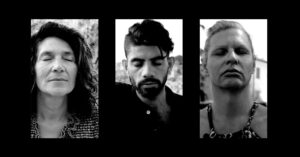
«A OJOS CERRADOS» (Roma, 2022, IT).