ES: Aramburo. Bolivia. Trabajo sin carnet de residencia: Ch’ixi —palabra aymara para un gris hecho de puntos blancos y negros que se tocan y no se mezclan: ni dentro ni fuera de ninguna tradición, en fricción con todas. Treinta años y más de cincuenta obras —con Kiknteatr y en instituciones y espacios que van de Québec a Quito y Basilea— y doce Premios Nacionales de Teatro en Bolivia. Desde 2020 el mismo método pasa por instalaciones, obras duracionales transmedia, videoensayos, películas, una máquina de traducción contextual y cartas escritas a mano. Una sola contante: sacar el material de la ruina de la propia formación, darle tiempo, dejar las costuras a la vista y devolver lo que se tomó.
EN: Aramburo. Bolivia. Work without residency papers: Ch’ixi —the Aymara word for a grey made of black and white points that touch and never blend: not inside any tradition, not outside, in friction with all of them. Thirty years, more than fifty creations —with Kiknteatr and in cultural institutions and centers from Québec to Quito to Basel— twelve National Theatre Awards in Bolivia. Since 2020 the same method has been working through instalative works, durational and transmedia creations, video essays, films, a machine that translates contextually, and hand-written letters. One constant throughout: take material from the ruin of your own training, give it time, leave the seams showing, and pay back what you took..
«Aramburo transforms observation into a performative process… ‘Leyes’ is a creation that specifically addresses the danger posed by the ridiculous spectacularization of politics.»
RUY FILHO / Antropositivo, Brazil/Portugal.
a
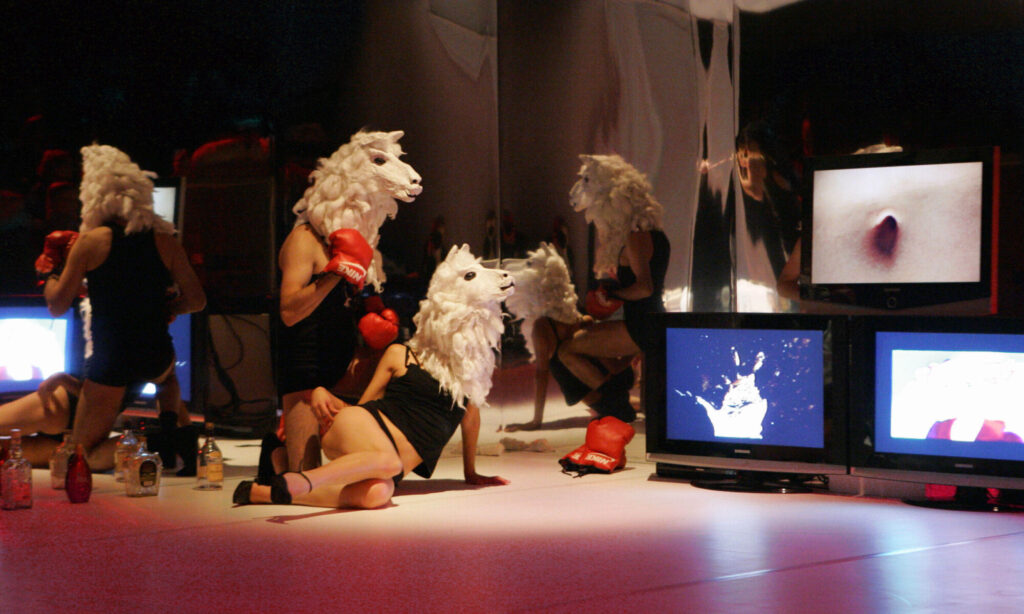
«MORALES» (Santos, 2014, BR)
a
GLOSSARY
CH’IXI:
ES: Palabra aymara. Gris que no es mezcla: puntos blancos y negros que se tocan sin fundirse (S. Rivera Cusicanqui, 2010). El color del perro de la calle cuando corre. Aquí nombra una posición, ni dentro ni fuera (de ninguna tradición). No hay regla ni traducción limpia, y ese es el punto.
EN: Aymara word. A grey that is not a blend: black and white points that touch and never fuse (S. Rivera Cusicanqui, 2010). The colour of a street dog while it runs. Here it names a position, neither inside nor outside (any tradition). There is no clean rule or translation, and that is the point.
QHIP NAYRA
ES: El pasado va delante (delante los ojos/nayra, es lo que vimos); el futuro detrás, sin ver. Se avanza de espaldas/qhip. No es una metáfora, es el modo de tiempo del trabajo y de los relatos.
EN: The past ahead (in front of our eyes/nayra, we saw it); the future behind/qhip, unseen. One walks backwards. It is not a metaphor, it is the working method of time here and of stories.
AYNI
ES: (Concepto andino). Reciprocidad debida (contrato ontológico): una deuda que se paga con otra deuda. Con el archivo, con el cuerpo, con el material: lo que se toma se devuelve, en tiempo.
EN: (Andean concept). Due reciprocity (ontological contract): a debt repaid with another debt. With the archive, the body, the material: what is taken is given back, in time.
MALLKI
ES: El ancestro momificado que se alimenta; en quechua es también la planta joven que se siembra. Muerte y semilla en una sola palabra.
EN: The mummified ancestor who is fed; in Quechua also the young plant that is sown. Death and seed in a single word.
KYNIKOS
ES: Del griego kyōn, perro. Filosofía que se hace con el cuerpo, sin pedir permiso. No es el cinismo moderno (Sloterdijk): no ironiza la norma, actúa como si no existiera.
EN: From the Greek kyōn, dog. A philosophy done with the body, without asking for permission. Not modern cynicism (Sloterdijk): it does not mock the norm, it acts as if the norm did not exist.
PEGADO CON CHICLE
ES: Pegar con un material mínimo que deja ver la costura. En Crudo (2004), una bolsa de suero sostenida con chicle aguantó años de gira. El chicle es el método; la herida, la ética.
EN: Joining with a minimal material that shows the seam. In Crudo (2004) a drip bag held with chewing gum lasted years on tour. The gum is the method; the wound, the ethics.
v
DA
DA